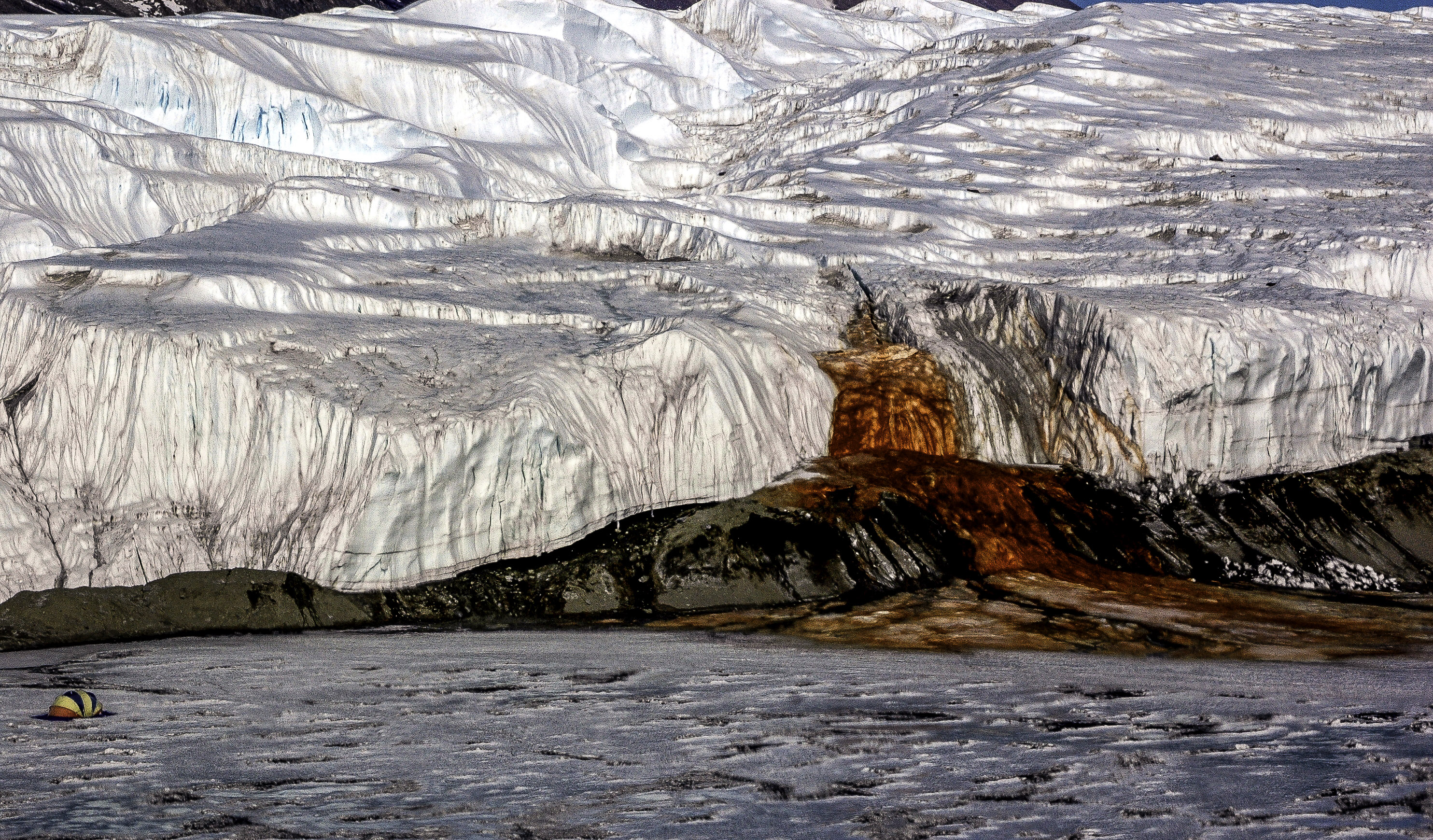
In the vast, icy expanse of Antarctica, where pristine white landscapes stretch as far as the eye can see, there exists a startling anomaly that appears as if the glacier itself is bleeding. Blood Falls, a rust-colored waterfall flowing from the Taylor Glacier in Antarctica's McMurdo Dry Valleys, presents one of Earth's most visually striking and scientifically fascinating natural phenomena. This crimson outflow, staining the white face of the glacier and the ice-covered surface of Lake Bonney below, has captivated scientists and visitors alike since its discovery over a century ago.
The Mystery Unveiled
When Australian geologist Griffith Taylor first discovered this peculiar feature during an expedition in 1911, he initially attributed the red coloration to algae. This was a reasonable assumption at the time, as red algae are known to thrive in extreme environments. However, the true explanation would prove far more extraordinary and would take nearly a century to fully unravel.
For decades, the blood-red waterfall remained a scientific enigma, with various theories proposed to explain its unusual appearance. It wasn't until the early 2000s that researchers began to piece together the complex story behind Blood Falls, revealing a tale that spans millions of years and involves ancient microbes, subglacial lakes, and unique geochemical processes.
The breakthrough came when scientists discovered that the source of the red coloration was not biological in origin, at least not directly. Instead, the vivid crimson hue comes from iron oxides—essentially rust. When the iron-rich water from beneath the glacier comes into contact with the oxygen in the air, the dissolved ferrous iron (Fe²⁺) oxidizes to ferric iron (Fe³⁺), creating the striking blood-red color that gives the falls their name.
But this explanation only raised more questions: Where was this iron coming from? How had it remained in solution beneath the glacier? And perhaps most intriguingly, could anything actually live in such an extreme environment?
The Ancient Subglacial Ecosystem
The answers to these questions revealed an even more fascinating story. Approximately 2 million years ago, when sea levels were higher, the Taylor Valley was flooded with seawater. As the climate cooled and sea levels dropped, this marine water became trapped and eventually covered by the advancing Taylor Glacier. This ancient seawater, now a hypersaline brine about three times saltier than the ocean and rich in iron and sulfur compounds, has remained liquid despite being buried beneath 400 meters of ice in temperatures well below freezing.
This subglacial reservoir has been isolated from the outside world for millions of years, creating what scientists call a "time capsule" of ancient marine conditions. The extreme pressure from the overlying glacier, combined with the high salt content of the water, prevents it from freezing even at temperatures as low as -5°C (23°F).
But perhaps the most extraordinary discovery came in 2009 when researchers found that this inhospitable environment harbors a community of microbes that have evolved to survive without oxygen or sunlight. These remarkable organisms have been isolated from the rest of the world for millions of years, forced to adapt to their extreme habitat by developing unique metabolic pathways.
Unlike most life on Earth that relies on photosynthesis or oxygen for energy, these microbes survive by "breathing" iron and sulfur compounds. They extract energy by facilitating the chemical reaction between the iron and sulfate in the brine, essentially using these minerals the way we use oxygen. This metabolic process, known as chemosynthesis, allows them to survive in one of the most extreme environments on our planet.
The microbes' activity actually contributes to the chemical composition of the brine, helping to keep the iron in its reduced, soluble form (Fe²⁺) until it reaches the surface and contacts atmospheric oxygen. This microbial community represents one of the most extreme examples of life's adaptability on Earth and has profound implications for our understanding of how life might exist in similarly harsh environments elsewhere in the universe.
Scientific Significance
The discovery of this ancient ecosystem beneath the Taylor Glacier has had far-reaching implications across multiple scientific disciplines. For astrobiologists, Blood Falls provides a terrestrial analog for potential habitats on other worlds, particularly icy moons like Jupiter's Europa or Saturn's Enceladus, which are thought to harbor subsurface oceans.
The microbes of Blood Falls demonstrate that life can exist in environments completely isolated from sunlight and oxygen, surviving on nothing but the chemical energy available from mineral compounds. This expands our understanding of the potential habitable zones in our solar system and beyond, suggesting that life might be more resilient and widespread than previously thought.
For glaciologists, Blood Falls offers a rare glimpse into the subglacial environment without the need for expensive and logistically challenging drilling operations. The outflow provides a natural "window" into processes occurring beneath the ice, helping scientists understand the complex hydrology of glaciers and ice sheets.
The unique geochemistry of Blood Falls has also attracted attention from geologists and geochemists. The interaction between the ancient marine brine, the overlying glacier, and the microbial community creates a natural laboratory for studying mineral transformations, brine evolution, and biogeochemical cycling in extreme environments.
In 2017, researchers made another significant discovery about Blood Falls when they used radio echo sounding to map the path of the brine through the glacier. They found that the saltwater travels through a complex network of channels and cracks in the ice, following the path of least resistance to eventually emerge at the glacier's terminus. This finding challenged the previous understanding of glacier hydrology, which had assumed that water couldn't travel through solid ice without refreezing.
Most recently, in 2023, scientists from Johns Hopkins University and the University of Colorado Boulder used novel techniques to determine that the brine reservoir beneath Taylor Glacier is much more extensive than previously thought, potentially connecting to a larger subglacial hydrological system. This research suggests that similar subsurface brine networks might exist elsewhere in Antarctica, with important implications for our understanding of subglacial ecosystems and their potential influence on ice sheet dynamics.
Accessing and Viewing Blood Falls
Located in the McMurdo Dry Valleys, one of the most extreme deserts on Earth and one of the few ice-free areas in Antarctica, Blood Falls is not easily accessible to casual visitors. The region is protected as an Antarctic Specially Managed Area (ASMA) due to its scientific importance and ecological sensitivity.
Research expeditions to Blood Falls typically operate out of McMurdo Station, the largest research station in Antarctica, located on Ross Island about 100 kilometers away. Access to the site requires helicopter transport and special permits, with strict protocols in place to minimize human impact on this pristine environment.
For scientists working at Blood Falls, the challenges are considerable. The extreme cold, with temperatures rarely rising above freezing even in summer, combined with the region's aridity and strong katabatic winds, creates harsh working conditions. Researchers must carefully plan their sampling strategies to avoid contaminating the site while also protecting themselves from the elements.
Sampling the brine directly from the outflow allows scientists to study its chemical composition and microbial community without disturbing the subglacial environment. However, the flow is not constant throughout the year, with the most active discharge typically occurring during the austral summer (November to February) when slightly warmer temperatures allow more brine to escape from beneath the glacier.
While direct access to Blood Falls is limited to scientific expeditions, the striking images of this crimson cascade against the white backdrop of the glacier have captured public imagination worldwide. These photographs, along with scientific documentaries and virtual tours, allow people around the globe to appreciate this natural wonder without physically visiting the fragile Antarctic environment.
Similar Phenomena Around the World
While Blood Falls is unique in many ways, similar iron-rich discharges occur in other locations around the world, though none are quite as dramatic or well-studied. These analogous features provide valuable comparative data for scientists studying the processes at work in Blood Falls.
In the Canadian Arctic, on Devon Island, researchers have documented iron-stained ice features that share some characteristics with Blood Falls. These "rust streaks" form when iron-rich groundwater seeps to the surface and oxidizes, creating reddish stains on the ice and snow.
In Spain's Rio Tinto (literally "Red River"), acidic, iron-rich waters create a similarly striking red coloration. Unlike Blood Falls, however, the Rio Tinto's color comes from both iron oxidation and extremophile microorganisms that thrive in its highly acidic waters (pH 2). These microbes, like those in Blood Falls, have adapted to extreme conditions and use iron in their metabolic processes.
Iron-rich springs in Yellowstone National Park also create rusty deposits as iron-oxidizing bacteria facilitate the transformation of dissolved iron into solid iron oxides. These springs, while visually different from Blood Falls, involve similar biogeochemical processes.
What makes Blood Falls stand out among these similar phenomena is its dramatic appearance, its location on the face of a glacier, and the ancient origin of its source water. The combination of the stark white background of the Taylor Glacier with the vivid red of the outflow creates a visual contrast unmatched by other iron-rich discharges. Additionally, the extreme isolation of the subglacial ecosystem and its potential as an analog for extraterrestrial environments gives Blood Falls particular scientific significance.
Conservation and Protection
The McMurdo Dry Valleys, including Blood Falls, are protected under the Antarctic Treaty System as an Antarctic Specially Managed Area. This designation recognizes the region's exceptional scientific value and aims to minimize human impact while facilitating research activities.
The management plan for the area includes strict guidelines for visitors, whether scientists or support personnel. These guidelines cover waste management, movement within the area, sampling protocols, and measures to prevent the introduction of non-native species. All research activities must be approved in advance and conducted in a manner that minimizes disturbance to the environment.
Climate change poses a potential threat to Blood Falls and the unique ecosystem it represents. As global temperatures rise, changes in glacier dynamics could alter the flow of the brine or even eventually lead to the retreat of the Taylor Glacier. While the subglacial reservoir has remained stable for millions of years, the rapid pace of current climate change introduces uncertainty about its future.
Monitoring programs track changes in the flow rate, chemical composition, and microbial community of Blood Falls over time. These observations help scientists understand how this unique feature responds to environmental changes and may provide early warnings of significant alterations to the system.
The scientific community recognizes the importance of preserving Blood Falls not only as a natural wonder but also as a valuable research site. The ongoing discoveries made at this location continue to expand our understanding of life's adaptability and the complex interactions between geology, glaciology, and biology in extreme environments.
Conclusion: A Window into Earth's Hidden Ecosystems
Blood Falls stands as a vivid reminder that our planet still harbors secrets in its most remote corners. This crimson outflow from the Taylor Glacier represents far more than a visual curiosity—it provides a glimpse into a hidden world where life has found a way to thrive in conditions once thought incompatible with biological processes.
The story of Blood Falls is one of scientific discovery and persistent inquiry. What began as a geological curiosity noted by early Antarctic explorers has evolved into a multidisciplinary research site yielding insights relevant to fields ranging from microbiology to astrobiology. Each new investigation has peeled back another layer of this complex natural system, revealing ever more fascinating details about the processes at work beneath the ice.
For the microbes that inhabit the subglacial brine, Blood Falls represents the only connection to the outside world they have had in millions of years. These ancient organisms, descendants of marine microbes trapped when the ocean retreated from the valley, have evolved in isolation to create a unique ecosystem unlike any other on Earth. Their ability to survive without sunlight or oxygen, instead deriving energy from chemical reactions involving iron and sulfur, expands our understanding of life's fundamental requirements and adaptability.
As we continue to explore extreme environments on Earth, from the deepest ocean trenches to the driest deserts, discoveries like Blood Falls remind us that life is remarkably tenacious and diverse. The existence of thriving microbial communities in such harsh conditions suggests that life might exist in places we once considered barren, both on our own planet and potentially elsewhere in the universe.
In its striking appearance and scientific significance, Blood Falls embodies the wonder of natural phenomena—how ordinary processes like oxidation can create extraordinary features when they occur in unique contexts. It stands as a testament to the complex and often hidden processes that shape our planet, processes that continue whether or not human eyes are there to witness them.
As research continues at Blood Falls, each new finding adds to our appreciation of this remarkable feature and the insights it provides into Earth's hidden ecosystems. In the crimson flow emerging from the white face of Taylor Glacier, we find not only a visually stunning natural phenomenon but also a window into the remarkable adaptability of life and the countless wonders that still await discovery in Earth's most extreme environments.
Image Credit: Blood Falls in Antarctica - Photo by National Science Foundation/Peter Rejcek, public domain via GoodFreePhotos.


 Posts
Posts


No comments:
Post a Comment